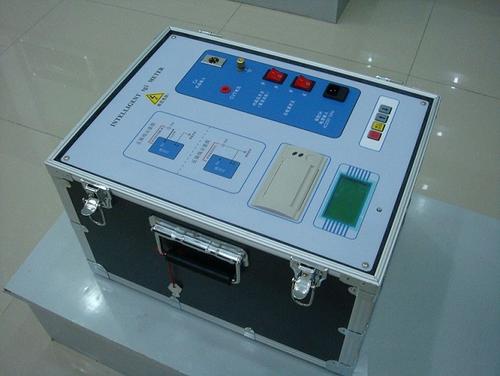

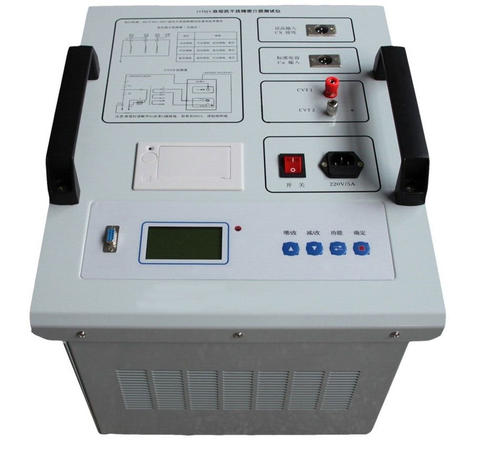
HV9002 High-Voltage Variable Frequency Anti-Interference Dielectric Loss Tester
The HV9002 High-Voltage Variable Frequency Anti-Interference Dielectric Loss Tester is a high-precision testing instrument specifically designed for evaluating the insulation performance of high-voltage power equipment. It is widely used in power plants, substations, and other field or laboratory settings, primarily for detecting the dielectric loss tangent (tanδ) and capacitance (Cx) of power transformers, instrument transformers, insulating bushings, capacitors, surge arresters, and other equipment.
I. Core Working Principle and Technical Features
Variable Frequency Anti-Interference Technology: The instrument uses a variable frequency power supply and PID algorithm, filtering out on-site 50Hz power frequency interference through Fourier transform. Even in strong electromagnetic interference environments, it can isolate the fundamental wave of the signal, ensuring reliable data measurement.
Complex Current Method and High Precision: It employs the complex current method for vector operations, combined with high-precision digital measurement circuits, to automatically complete the measurement of capacitance and dielectric loss, achieving high accuracy in test results.
Multiple Safety Protections: It features multiple protection measures including input voltage fluctuation, output short circuit, overvoltage, overcurrent, and temperature protections. It also includes a grounding detection function; if grounding is poor or there is misoperation, the instrument will refuse to boost voltage or immediately cut off high voltage, ensuring the safety of personnel and equipment.
Integrated and Intelligent Design: It adopts a fully integrated structure with built-in standard capacitors and high-voltage power supply, reducing on-site wiring. It is equipped with a large LCD Chinese touch screen for intuitive operation, supporting massive data storage and USB drive export.
II. Main Technical Parameters (Referencing Industry Standards of Similar Level)
High-Voltage Output Range: 0.5kV to 10kV (continuous smooth adjustment)
Measurement Accuracy: Capacitance Cx: ±(reading × 1.0% + 1pF); Dielectric Loss tgδ: ±(reading × 1.0% + 0.04%)
Resolution: tgδ: 0.001%; Cx: 0.001pF
Test Frequencies: Supports single frequencies of 45Hz, 50Hz, 55Hz, 60Hz, 65Hz, as well as automatic dual-frequency modes such as 45/55Hz and 55/65Hz
Maximum Output Current: 200mA (with internal high voltage)
Executed Standards: Complies with power industry standard DL/T 846.17—2025 "General Technical Conditions for High-Voltage Test Equipment"
III. Core Test Functions
Conventional Dielectric Loss Measurement: Supports positive connection and reverse connection methods, suitable for insulation testing of various conventional high-voltage equipment.
CVT (Capacitive Voltage Transformer) Testing: Supports CVT self-excitation method testing, allowing measurement of C1 and C2 capacitance and dielectric loss in one test without external accessories; supports testing without disconnecting high-voltage leads, as well as reverse shielding method for measuring the upper C0 of CVT.
Oil Dielectric Loss Measurement: High measurement accuracy; with a standard oil cup and dedicated test leads, it can measure the dielectric loss of insulating oil.
IV. On-Site Operation and Safety Precautions
Reliable Grounding: Before use, the instrument's grounding terminal must be reliably connected to the grounding grid. Poor grounding may cause machine protection or danger.
High-Voltage Cable Specifications: During testing, the outer shield of the high-voltage cable must be properly grounded (when testing CVT separately, the outer shield should be left floating to reduce errors), and neither the high-voltage core wire nor the shield wire is allowed to contact the low-potential part of the test circuit.
Prevention of "Capacitive Rise" Effect: When measuring large-capacitance test objects, the instrument can automatically track the output voltage to maintain a constant test voltage, preventing voltage elevation.
Emergency Shutdown: After test initiation, if a sudden situation endangering safety occurs, the emergency stop button can be pressed directly or the main power can be turned off to immediately cut off the high-voltage output.