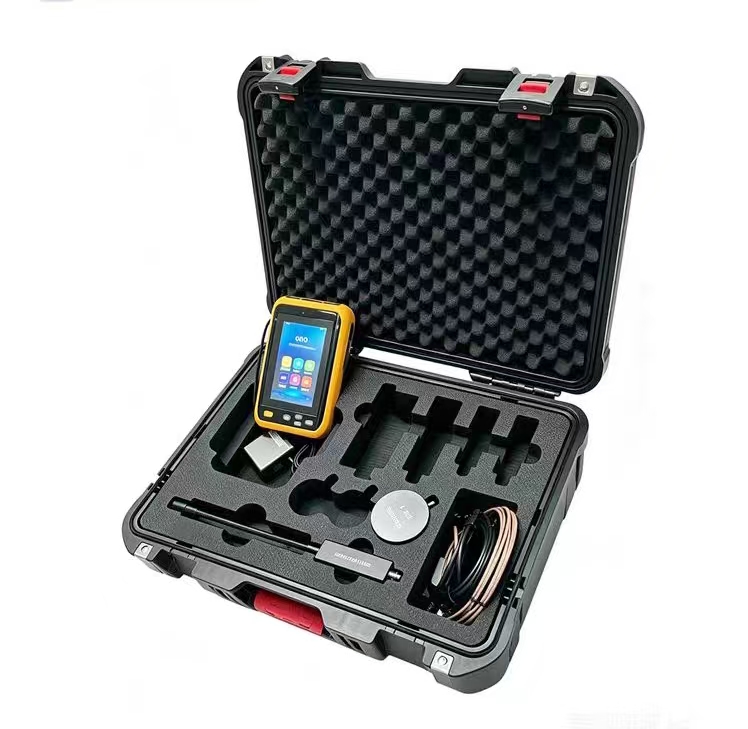

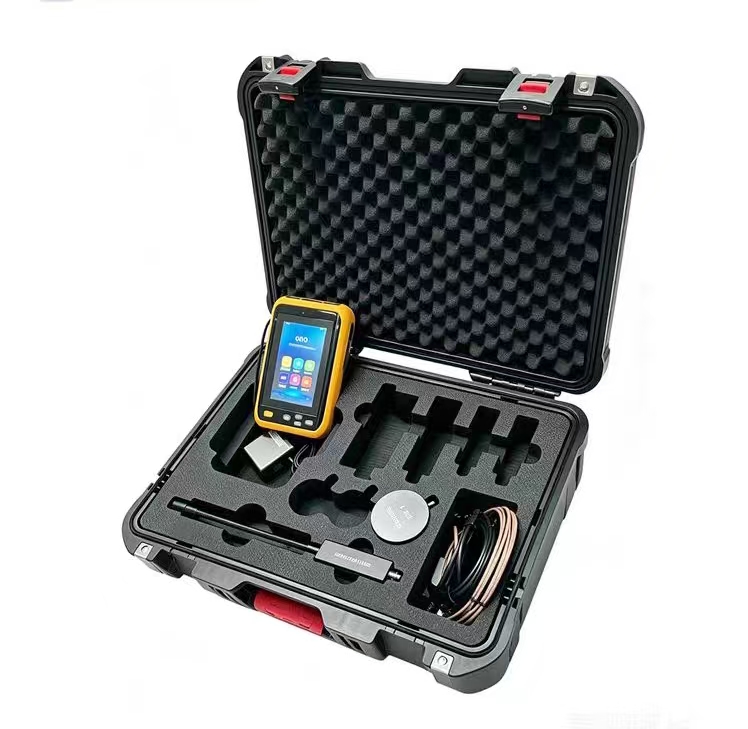
Online Partial Discharge Tester
An online partial discharge tester (partial discharge online monitoring system) is a professional system used for real-time monitoring of the insulation status of medium and high voltage power equipment (such as cables, GIS, switchgear, transformers, etc.). Unlike traditional outage tests or manual handheld inspections, it captures discharge signals inside the equipment 24/7, transforming operation and maintenance management from "passive repair" to "active prevention", thereby effectively avoiding sudden failures of high-voltage equipment.
⚙️ Core Working Principle and System Architecture
The online partial discharge monitoring system typically adopts a three-layer closed-loop architecture of "end-edge-cloud", capturing discharge signals comprehensively through multiple sensors:
Perception layer (sensors): Sensors are installed at key parts of the equipment to capture different types of partial discharge signals.
Edge computing layer (collectors): Front-end collectors amplify, filter, and perform analog-to-digital conversion on analog signals, along with preliminary interference processing and feature extraction.
Cloud/backend layer (servers and software): Data is transmitted to backend servers via optical fiber or wireless networks, where expert analysis systems perform classification and identification, trend calculation, and ultimately generate spectrograms and diagnostic reports.
Common Detection Technologies and Sensors
Depending on the detection principle, the system typically uses one or more of the following sensors for combined cross-validation:
High-frequency current transformer (HFCT): Based on the Rogowski coil principle, it is clamped onto cable grounding wires or cross-bonding wires to accurately couple partial discharge pulse current signals in the 1MHz to 100MHz frequency band. Its clamp structure allows installation without power outage and has strong anti-interference capability.
Ultra-high frequency sensor (UHF): Captures UHF electromagnetic wave signals generated by partial discharges in the 300MHz to 3GHz range. This frequency band has extremely strong anti-interference capability and supports discharge point location, commonly used for internal monitoring of GIS equipment.
Acoustic emission sensor (AE): Detects acoustic signals generated by partial discharges in the 20kHz to 60kHz range. It is highly sensitive to mechanical vibrations and is particularly suitable for detecting mechanical damage defects in weak insulation parts such as cable joints and terminations.
Transient earth voltage sensor (TEV): Mainly used for live detection of partial discharges in metal-enclosed equipment such as switchgear.
Main Application Scenarios
Online partial discharge monitoring systems are widely used for condition monitoring of the following core power assets:
Power cables: Monitors insulation aging and treeing degradation at cable bodies and joints, providing double-ended location capability with accuracy up to ±3 meters.
Gas-insulated switchgear (GIS): Monitors partial discharge electromagnetic wave signals at positions such as basin insulators inside GIS equipment to assess operating status.
Switchgear: Continuously collects data from rows of switchgear in 10kV/35kV distribution rooms, suitable for trend monitoring and threshold alarming of critical equipment.
Rotating machines and transformers: Continuously monitors the insulation system status of generators, motors, and power transformers, providing in-depth trend analysis to prevent costly failures.
Core Functions and Advantages
Real-time monitoring and alarming: Displays parameters such as discharge magnitude, discharge phase, and discharge count in real time, and triggers alarms when signals are abnormal.
Intelligent spectrogram analysis: The backend software supports PRPD/PRPS spectrogram analysis, identifies fault modes combined with expert database data, and automatically distinguishes interference from real defects.
Historical trend tracking: Automatically stores test spectrograms and discharge trends, capturing early insulation defects through long-term data comparison.
Remote monitoring: Supports remote access to data via LAN, internet, or even smartphones, breaking spatial limitations.
Selection and Implementation Recommendations
When selecting an online partial discharge monitoring system, it is necessary to clarify its differences from "portable inspection devices" and "laboratory general-purpose analysis systems", with key considerations as follows:
Long-term stability: The core value of online monitoring lies in connecting multiple readings into trends, so the long-term stability and anti-environmental interference capability of sensors are crucial.
Data management and communication: Confirm whether the system supports standard communication protocols such as IEC 61850, and whether it can smoothly integrate into existing substation integrated automation systems or data centers.
Alarm strategy: The system should have flexible threshold settings and graded alarm functions (such as normal, attention, abnormal, severe) to avoid false alarms leading to maintenance fatigue.
Subsequent operation and maintenance costs: Online systems are long-term investments, so full lifecycle costs including software upgrades, sensor calibration cycles, and technical support response times should be included in procurement evaluation.